Wednesday, October 31, 2007

HAPPY HALLOWEEN!


Wasn't she just "cute as a bug"!!?? Trick-or-treating and teething, too!

Eikos Maya ollut aivan ihana otokka!! Viela ne uudet hampaat kiusaavat...

Tuesday, October 30, 2007

No wonder... Ei ole ihme...


We had a HORRIBLE night last night!! First, Maya did not take a nap yesterday. And last night Maya just cried and cried. I thought that she didn't feel well because she did have that ear infection last week and she also has a little cough. I laid on her floor next to her crib, I took her to lay on the couch, we even tried to have her sleep in bed with AKi and I. (The sleeping with us DOES NOT work... Maya just thinks that it's just so much fun to be in bed with Mom and Dad and that it's time to PLAY!!) I finally gave in and just gave her some ibuprofen and she fell asleep.
And, low and behold, when I looked into her mouth today, there were her two bottom corner teeth just breaking the skin! Poor thing has been teething AND coughing AND getting over an ear infection!!

Meilla oli ihan hirvea yo viime yona!! Ensiksi, Maya ei nukkunut paivanunia eilen. Sitten illalla Maya itki ja itki. Mina ajattelin etta hanella on huona olla ehka sen viimen viikon korvatulehduksen takia tai sitten yskan takia. Mina makasin lattialla Mayan sangyn vierella, mina otin Mayan sahvalle nukkuu. Yritettiin laittaa Mayan meidan keskelle nukkuu... se ei kylla onnistu! Maya innostui siita kun sai olla sangyssa Aitin ja Isin kanssa ja han vaan haluisi LEIKKIA!! Sitten laitoin Mayan omaan sankyyn ja annoin ibuprofiinia ja sitten neiti nukahti. Ja kun katoin Mayan suuta tanaan siella oli 2 alimaista kulma hammasta tullut lapi!!

Thursday, October 25, 2007

Bethel's taxi situation

This was on the NY Times website!!! It costs me $6 to take a taxi pretty much anywhere in Bethel from where I live. And we don't tip.


The Easiest Thing You’ll Do All Day in This Alaskan Town Is Hail a Taxi

By THE ASSOCIATED PRESS
Published: July 22, 2007

BETHEL, Alaska, July 21 (AP) — You will not find a luxury hotel or concert hall here in Bethel. But this remote Alaska town has at least one advantage over New York: It may be the nation’s taxicab capital.

Gim Jong-ihn waited for a rider in Bethel, Alaska, in May. The small town has one cab for every 84 people.

Situated on the tundra about 400 miles west of Anchorage, Bethel has 70 taxis for a population of just 5,900. That is one cab for every 84 people.

That is more even than New York, the ultimate cab city, where there is one hired vehicle like a taxi, commuter van or livery car for every 149 people.

“It’s most likely by far the highest ratio of taxis per residents in the United States,” said Alfred LaGasse of the Taxicab, Limousine & Paratransit Association.

Bethel, which is surrounded by thousands of ponds in a delta plain, is inaccessible by road. If residents want to own their own car, they must fly one in or bring it by barge on the Kuskokwim River, and that is expensive.

“I bought a small Ford Focus and it cost $2,000 to fly it in,” said Mark Springer, chairman of the local transportation commission. “Then of course, there’s the cost of gas, almost $5 a gallon here. Cabs in Bethel are very, very convenient.”

Fewer than half the adults have their own car or truck. Some families own snowmobiles, but those are good only in winter.

As a result, taxi drivers — many of them non-Alaskans, mostly Koreans and Albanians — have flocked here to fill the gap. Cabs are seemingly everywhere, squeezing in passengers who pay $4 to go anywhere in the main part of town, and $6 to the airport three miles away.

The high number of vehicles for hire was a big surprise to Wally Baird when he moved here from Nebraska two years ago to take a job as city manager.

“In every place I’ve ever lived and worked you’re lucky to see even one cab,” Mr. Baird said.

Bethel is largely a collection of utilitarian buildings on stilts, simple homes and shacks, with water and sewer pipes built above ground because the permafrost below the surface is rock-hard.

But the town serves as a commercial hub for the vast region, with visitors from 56 largely Eskimo villages coming here to shop, see doctors or do other errands. Visitors arrive by plane the year round, by snowmobile in winter and by boat in summer.

Bethel also has a sizable number of teachers, police officers, medical workers and other professionals who stay only a few years before moving on. Many do not bother bringing a car.

Often, taxi passengers do not get a cab all to themselves. As novices soon discover, drivers make constant stops and passengers pile in.

On a recent shift, the driver, Jay Saliu, delivered passengers to the hospital, the school and to stores.

Among his fares was Vendella Evan, 19, a pregnant woman from the village of Akiachak heading to the hospital for a checkup. A Kwethluk resident, John Fisher, 24, got a 30-second ride after buying diapers at a grocery store. Kevin and Esther Smart of Napakiak were picking up their daughter’s school records.

Because cabs are shared, regulars like one Bethel resident, Joanna Simeon, know to leave plenty of time for travel.

“Newcomers think they’ll just hop in a cab and go right to work, then it stops 20 times,” Ms. Simeon said. “They get to see a lot of Bethel.”

Despite the flurry of business, cab drivers say the constantly rising price of gasoline is cutting into their earnings. There are other downsides, including steep insurance and dispatcher fees as well as the high cost of living. Earlier this year, cab drivers made an unsuccessful attempt to raise rates by a dollar.

Then there is the unsolved killing of a cab driver. In December, the driver, Joung Ju-young, 41, was shot in the face in what the police believe was a robbery attempt. The nighttime killing stunned the town and prompted many cab drivers to work only in daylight.

“When you work nights you don’t know what kind of person jumps in,” said Mr. Saliu, an Albanian from Kicevo, Macedonia.

Over all, though, Bethel suits many just fine, including Gim Jong-ihn, a 72-year-old driver.

“I have a job, there is fresh air and not too many people, like in New York,” Mr. Jong-ihn said.
More Articles in National »

10-25-07

Maya turned 15 months old yesterday!! She is doing much better and I checked her ears and they are healing nicely.
We have been in Bethel for 3 months on the 16th of October and I have been working at the Yukon Kuskokwim Health Corporation for 3 months as of the 23rd! Feels like we have been here much longer! Everything is going very well. Aki has poker night with "the guys" tonight
IT IS RAINING!! THe temps are in the upper 30's (which seem to now feel warm!)and it has rained for 2 days! The snow is melting and the roads again are becoming muddy potholes. Auuggh. I wish the snow would have stayed! I will put pictures of Maya soon!

Maya taytti 15kk eilen! Han voi paljon paremmin ja katoin henen korvat ja ovat terveita.
Ollan oltu Bethelissa jo 3 kk! Mina olen ollut toissa YKHC:Ssa 3kk 23.10.07. Tuntuu etta ollaan oltu paljon pitempaa taalla! Mutta kaikki menee tosi hyvin. Akilla on pokeri ilta "poikien" kanssa tana iltana.
TAALLA SATAA VETTA!! Lampotilat ovat just lammon puolella (mitka nyt tuntuu aika lampimalta!) ja on vetta tullut jo 2 paivaa. Lumi sulaa ja nyt meidan tiet ovat taas mutaisia ja ihan hirveessa kunnossa. Oispa lumi pysynyt!! Laitan uusia kuvia Mayasta pian!
THIS POST IS FROM
WWW.TUNDRAMEDICINEDREAMS.COM
ABOUT OUR TRIP TO NAPASKIAK.
(I am Claire!)

WRITTEN BY "THE TUNDRA PA":

Wednesday, October 24, 2007
Village Trip to Napaskiak

One of the more unique aspects of my job—and one of the most enjoyable—is traveling to a village and spending several days working with health aides and seeing patients in the small village clinic. Life has a different pace and a different focus in the villages, and it is refreshing to experience that.

Napaskiak is a Yupik Eskimo village of about 370 people located 14 miles downriver from Bethel. The people of this village have relatively easy access to Bethel for shopping and health care compared to people from the farther villages. Napaskiakers easily travel in by boat in the summer and by snowmachine in the winter. During the difficult transition periods around breakup and freezeup of the river, they come by small planes operated by the commercial charter services which offer scheduled service; a round trip ticket is about $120 for the seven-minute flight.

After three years as the assigned health care provider for this village, I finally had the opportunity to make an official hospital-sponsored village trip last week. It was the first time they had had a provider visit in four years.

Pulling off a village trip that runs smoothly requires some planning and preparation. The health aides are notified as far ahead as possible that the trip will happen and are encouraged to begin putting together a list of the patients they consider the most ill, the most fragile, the most home-bound in the village. They are also asked to start creating a list of equipment and supplies that they are short on. The Village Operations department of the hospital does a good job of supplying the village clinics, but many health aides tell me that at times they just can’t get certain things. The tiny blue ear scoops for removing ear wax is one example.

The hospital, of course, wants me to see as many patients as possible in the time I am there. And they want me to see all of the patients in certain categories: all the pregnant women, all the children under one year of age, all the people with diabetes, all the home-bound elders, and as many as possible of the patients who are on chronic medications. In addition to seeing patients, other activities are encouraged as well, such as going to the school and giving health talks to the students, or meeting with the village’s Tribal Council to discuss health issues of concern to them.

For this trip, I also had the pleasure of company. A newly-hired PA on our medical staff, Claire (NHRM), was assigned to go with me and learn how to do a village trip. Claire is a delightful and enthusiastic young woman who has been a PA for several years; she is excited about having moved to Bethel and taking up the work we do here with the Yupik people. She is a wonderful addition to the medical staff and I greatly enjoy working with her. This was her first village visit, and she was nearly vibrating in anticipation.

Our flight across the river left Bethel at 8:30 in the morning, just before sunrise. We were the only passengers in a small four-seater plane and the trip literally took about five minutes. We never flew above 300 feet. When we landed at the airstrip, the charter company’s agent was there to meet us on a four-wheeler pulling a small trailer. Our gear went into the trailer and Claire and I climbed on the four-wheeler behind the agent. He drove us over the boardwalk the half mile or so to the village clinic.

Napaskiak is laid out in one long line bordering a slough just at its entrance to the main Kuskokwim River. A well-maintained boardwalk extends from one end of the village to the other—perhaps a mile—with houses one or two deep on either side of the boardwalk. The houses are not numbered or named; everyone knows where everyone lives. The clinic, the school, and the store are located in the center of the village; the big Russian Orthodox church is at one end of the village and a small one is at the other. The post office is close to the small church.

Four-wheelers are the transportation of choice in Napaskiak. They go everywhere, and the boardwalk is wide enough for two vehicles to pass each other. Most people have a trailer to pull behind their vehicle; this is how they get their water. The village has a small water treatment plant with a large outdoor spigot labeled “Public Watering Point.” Homes have one or more 33-gallon plastic garbage cans designated as water containers; these are loaded on the four-wheeler’s trailer, filled at the Watering Point, and carried into the home to be dipped from as needed. Living with dipped water adds a whole other level of complexity to life; we easily take for granted the ease of turning a faucet in the kitchen or bathroom and having fresh, drinkable water flow out endlessly.

It was shortly after 9 am when we carried our gear into the clinic and greeted the two health aides, Harold and Aggie, and the clinic clerk, Katya. What we noticed right off was that they all had their coats, hats and gloves on. It was pretty chilly in the clinic.

“No heating oil,” said Harold. The clinic’s tank had run dry the evening before and the furnace had shut down. Normally the tank is refilled before it gets so low, but the entire village had been low on heating oil for several days. Fortunately, a fuel barge had stopped at the village the day before and filled the main storage tank, so the clinic’s maintenance man was able to go that morning and get fuel to restart the furnace. It would take several hours before the building was warm again.

Claire and I decided that the time could be best used by doing home visits on elders. Harold grabbed a couple of charts and the health aide home visit kit (BP cuff, oxygen saturation monitor, stethoscope, thermometer, first aide supplies) and the three of us climbed on the clinic’s four-wheeler.

Our first stop was at the home of Lillian, the village’s oldest resident. Her age is listed in her hospital chart as 95 years, but her family says she is actually about six years older than that. Many elders in the Yukon-Kuskokwim Delta have uncertain birth dates; eighty years ago, such records were not kept. The local missionaries back then often assigned birth dates arbitrarily, and tended to use the date of first communion as the birthday.

Lillian welcomed us to her home, which was thankfully warm. She speaks no English at all, but Harold translated readily. She lives with her granddaughter, who takes care of her in the evening and does the cooking; but in the daytime she is home alone, as her granddaughter has a job. Lillian’s eyesight is failing but she gets around in the small house without bumping into things. She is at increased risk of falling, and we were there because she had fallen a few days earlier and the family was worried about her.


Claire and I checked her pretty thoroughly and she seemed well enough. Clearly there were no broken bones, and we only found one small bruise. Her upper and lower extremity strength were both quite good—likely the result of a lifetime of hard physical labor. A Yupik woman born in 1905 could expect nothing else. Her gait was slow and halting, but she picked her feet up well with each step. The family was hoping we could get her a wheeled walker to use in the house. I pulled out my clipboard and put that down as the first item on a list of things to be done on our return to Bethel.

The next stop was at the home of a man in his seventies who had had a moderately severe stroke some years earlier. His right arm and leg had marginal function. He sat in his wheelchair and could move around the house by pulling himself forward with his left leg. His wife wondered if we could get him a bedside commode, as she had trouble helping him get to the honey bucket in the middle of the night. Item two on the list.

Our third stop was to see a young mom who had called the clinic that morning because her two-week old baby was coughing. She has seven other children; the oldest three are in school, but the five-, three-, and two-year-old are home with her and the baby, and taking them all with her to the clinic for the baby to be checked was more than she could manage.

“Is it bronchiolitis?” she asked somewhat hopefully as soon as we were introduced. She knows about bronchiolitis. Most of her kids have had it and she is quite proficient with albuterol and a nebulizer. She is also experienced at “pounding”—percussion and postural drainage, or P&PD. If it were bronchiolitis she could keep the baby at home, give him albuterol nebs and P&PD every four to six hours and have daily rechecks at the clinic. Her fear was that this was pneumonia, which would mean a trip to Bethel and probable hospital admission for the baby. That would require a complicated arrangement between her sisters and aunties and her husband to take care of the other children while she was gone.

We unwrapped the baby near the living room window where the light was good and were reassured by his ease of breathing. No blue lips or nailbeds, no grunting, minimal retractions. His temp was 99.8 rectally, his heart rate was 158 and his respiratory rate was 62. The sat monitor read 94%. Yikes.

Mom knew he needed a neb treatment, but since it would be his first, she wanted him checked first. Oh, yes, I thought, let’s do that RIGHT NOW.

His breathing sounded junky, full of moist rhonchi that the health aides often describe as “snoring lungs,” but he was alert and looking around and moving all extremities. Mom quickly set up the nebulizer, poured an ampule of albuterol into the cup and had the baby breathing medicine in no time. After the treatment she turned him over in her lap and effectively patted his tiny back, helping him cough up the small mucous plugs that were interfering with his oxygen saturation. The monitor now read a reassuring 97% and his respiratory rate dropped to the low forties. Since he was afebrile and responded quickly to the albuterol, I was reasonably sure that this was bronchiolitis and not pneumonia. But lack of fever in a neonate does not necessarily mean lack of bacterial infection; the hospital has a standing order that all infants less than eight weeks of age come in for a septic work up, including lumbar puncture, for any fever greater than 100.3 degrees.

Harold, Claire and I agreed that the baby could be watched closely for the next 24 to 48 hours, with nebs every four hours and daily rechecks at the clinic. If he seemed worse at any time to Mom, or if his temp went above 100.3, he would go to Bethel. By Medevac if necessary.

We returned to a warm clinic just before noon. The staff went home for lunch and Claire and I unpacked our gear in the itinerant sleeping room, which has two bunk beds, a microwave and sink. No refrigerator. With daytime temps in the thirties and nighttime temps in the twenties, I figured I could keep the half-and-half for my coffee from either freezing or spoiling by putting it outside in the daytime and inside next to the back door at night. Worked perfectly. The frozen dinners we brought simply stayed outside all the time. Thank goodness for a microwave.

The next few days went by in a flash. Claire and I both saw a steady stream of patients, but the pace seemed much more relaxed than at the hospital. There were no emergencies to wake us up in the middle of the night, which can easily happen in the villages, and for which I was grateful. Our evenings were quiet; fortunately both Claire and I are avid readers and were happy to have time for it. There is a television in the clinic, but it only picks up two channels and both of them are quite fuzzy. I had hoped we would be able to take a steambath with some of the village women, but that did not happen.

Our last morning there, two young children were brought to the clinic who were both fairly sick. One was a two-year-old who had been taking albuterol nebs for a week or so, now weaned down to once or twice a day, but she had suddenly developed a fever of 101.8 and now had “heavy eyes,” a common health aide descriptor for lethargy. We gave her back-to-back nebs times three with P&PD after each neb, but she did not perk up much. Her temp came down to 100.2 with a dose of ibuprofen. I put a call in to the pediatrician on call in Bethel and we discussed the case. She needed to come in on the next commercial flight that afternoon; in the meantime we would do hourly nebs and watch her. Dad stayed at the clinic with her while Mom went home to pack.

The second young child was a one-year-old named Max with one of the worst cases of impetigo I have ever seen. He had been on topical mupiracin ointment and oral cephelexin for a week, and the infection was spreading and getting much worse. Blood cultures drawn at his visit in Bethel five days earlier were positive for Staph. Though his temp was 101 and his rash looked horrendous, he was a smiling, happy, drooling baby.


This time I grabbed the digital camera from the telemedicine cart and took photos of Max. Then I logged on to the telemedicine program and created a case presentation for him: his demographic info, a brief history of this episode of illness, and the photographs. I sent it to the pediatrician in Bethel and then called her and told her it was coming. She pulled up the case, reviewed it with me, and we decided that Max also needed to come to Bethel on the afternoon commercial flight.

Claire and I finished up with patients about 3 pm and got paperwork and supplies packed that we needed to take back with us to Bethel. The agent for the charter company called at 3:30 and said that our two sick children and their mothers would be taking our seats on the flight. We were bumped. They would try to get another plane out in about two hours to get us, but weather was closing in and they might not make it. I looked out the window to see snow falling rapidly and visibility about half what it had been an hour earlier. “Welcome to the bush; it is all part of the experience,” I told Claire.

We had planned our food well, and neither of us had any left. I laughingly told Harold that he would have to cook dinner for us if we did not make it out that night. “You’ll make it,” he said seriously.

At 5:15 it was still snowing fairly heavily when the agent called again and said a plane would be coming for us in about thirty minutes. We piled our gear in the trailer and hopped on the four-wheeler behind Harold. Snow was stinging my eyes and my hands were freezing with fleece gloves on as we roared up the boardwalk to the airstrip. Harold was barehanded and did not seem to mind. “It’s not winter yet!” was all he said when I mentioned it.

No plane was in sight when we got to the airstrip, but another four-wheeler was waiting. On it was a young girl of 14 or so, an older woman and a screaming toddler. The girl and the woman patiently watched the sky. The child just screamed. Thank goodness this is a short flight! I thought to myself.

Soon we heard the buzz of the plane’s engine and in no time it was pulling up in front of us. The people on the other four-wheeler had no luggage and just watched as Claire and I handed ours to the pilot who stowed it. We climbed into the six-seater and buckled ourselves in. Then the older woman came forward with the toddler and tried to put her into the plane. The child screamed even more, she fought, she tried to hold on to the woman.

“Would you hold her?” the woman said to Claire.

“Oh, well, sure,” Claire responded, thinking the woman wanted to get herself strapped in without fighting the child to do it.

“Thanks,” she said. “Here’s her bag. Her mother will be waiting in Bethel.” And with that she handed over a tiny purse-like bag and backed away from the plane! Claire and I looked at each other in disbelief.

The child was no longer fighting, but she was still screaming. Claire, mother of a toddler herself, put her arms around the little girl and began singing a lullabye. The child became quiet almost immediately. Crocodile tears shined in her eyes, but she did not make another sound.

“What do we do if her mother is not there?” Claire asked me.

“Let’s just hope she is,” I said.

We walked into the small waiting room in Bethel, which was full of people, carrying the silent child. “Is this child’s mother here?” yelled Claire over the din of many conversations. We looked around. No one came forward. After we toured the room repeating the question, a very thin young woman said “My baby!” At the sound of her voice, the child started crying. Mom comforted her and by the time we had collected our luggage she was smiling and laughing.

Claire and I looked at each other and laughed as we walked out the door. “Welcome to the bush!” we said in unison. It wouldn’t happen anywhere else.

Sunday, October 21, 2007

Maya


Maya had her 15 month well-child visit and we found out she had an ear infection in her left ear! She hasn't cried or had a fever, she just hasn't eaten as well this past week. Maya weighs 23.8lb and is 31.5 inches!!!

Mayalla oli 15kk tarkastus perjantaina ja saimme tietaa etta Mayalla oli korva tulehdus vasemassa korvassa! Maya ei ole koskenut sita korvaa, ei itkenyt eika kuumetta ollut. Maya ei ole vaan syonyt talla viikolla hyvin.
Maya painaa 10.8 kg ja on 79cm pitka!!

Rex and the Tundra.... Rekku ja Tundra


Aki has been taking great pictures!

Aki on ottanut erittain hyvia kuvia!

10-21-07


This morning it was 25F with a wind chill of 6F!! It was cold!!!

Tana aamuna oli -4C ja tuulen kanssa -14C! Oli kylma!!

Bethel Blondies


Maya goes to playgroup on Fridays and this past week these were the girls there!!

Maya kay leikkiryhmassa perjantaisin ja nama tytot olivat siella viime perjantaina

Thursday, October 18, 2007

Kuskokwim River... Kuskokwim Joki


Thomas the Tiger... Tiikeri Thomas


Thomas Weiler has saved this tiger for Maya for months already! Maya loves the tiger, Thomas! And we named the tiger after you! Anne-tati, Aki, Maya and Rex miss all of you Weiler children SOSOSOSOSOSOSO much!!

Thomas Weiler on lahettanyt tiikerin Mayalle ja Maya tykkaa siita kovasti!
As Napaskiak does not have trucks to bring water, the Napaskiakians take their Hondas and go get their water! They hook up tanks like these to the backs of their ATVs and bring water to their homes in this manner!

Napaskiakissa ei ole autoa milla voi vetta vieda ihmisten kotiin. Ihmiset vetavat tammoiset tankit perakarryissa ja vievat vetta omiin kotiin!


These are the people who work at the Napaskiak clinic: Katherine is the secretary who takes care of all the front paperwork, Herman is a health aide, Augusta is a health aide. They were such a big help for us during this visit!

Tassa on Napaskiakin klinikan tyontekiat: Katherine on sihteeri, Herman ja Augusta ovat terveydenhuoltajia. Olivat meille suuri apu kun olimme siella!


Now, let me tell you about this little girl, Michelle. We were getting ready to leave Napaskiak Wednesday afternoon. We were supposed to fly out on the earlier flight around 4pm or so, but we got bumped off the Bethel flight because we had to get 2 sick kids in to Bethel for treatment. After a few weather scares, we finally got the go ahead around 5:30 pm. Jane and I climbed into the 8 seater plane and this grandmother hands this child to me and says "Can you hold her?" I take her thinking that she will jump in the plane with us. Instead the grandma hands me the child's little bag and says that the girl's mom is waiting for her at the terminal in Bethel and slams the door shut. The girl is bawling her eyes out and I start Shushing and singing to her. I was a little worried because at this time I had no idea what this baby's name was, who her mother was and if there was positively going to be someone at the airport waiting for her. After the 5 minute flight, we landed and I was expecting someone to swoop down on me and just take this child out of my arm as soon as I stepped through the terminal door. Nope. Nobody even acted like they had seen this child before. I got nervous. I asked, "Does someone belong to this girl?" And finally, as I almost walked to the other end of the terminal, (and VERY nervous now!) the girl's mom shows up and the girl starts bawling again! I later found out from the mom Michelle's name and that she was 3 years old!! Yup'ic culture is so different!! They are so trusting of people!!

Nyt mina kerron tasta pikku tytosta nimelta Michelle. Me olimme lahdossa keskiviikkona Napaskiakista. Meidan ois pitanyt lahtee jo kello 16.00 mutta meidat siirettiin myohempaan lentoon kun oli 2 sairasta lasta ketka piti saada nopeasti Betheliin hoitoon. Meidan lento lahti klo 17.30. Kun noustiin koneeseen, tama mummo nosti tyttoa koneeseen ja kysyi etta voisinko ottaa tyton syliin? Mina ajattelin etta mina otan sen etta se mummo paasee ite nousemaan koneeseen. Mutta ei. Han antoi minulle sen tyton kassin, sanoi etta sen tyton aiti odottaa
Bethelin kentalla ja laittoi oven kiinni. Mina olin shokissa!! Tytto itki. Mina hossottin ja lauloin ja onneksi lapsi rauhoittui. Mina olin vahan huolissaan kun en tiennyt lapsen nimea, en tiennyt hanen aidin nimea, en teinnyt onko se aiti sittenkin odottamassa lastaan kentalla kun laskeudumme. No, onneksi oli niin lyhyt lento ja ajattelin etta heti kun astun terminaaliin joku nainen tulee ja nappaa tyttonsa mina kasistaan....ja se ei tapahtunut. Mina jannitin. Mina jo kerkesin kysela etta kuuluuko tama tytto kellekkaan. Mina kavelin melkein koko terminaalia lapi ennenkun Michellen aiti ilmestyi. Michelle rupesi heti itkemaan. Sain myohemmin tietaa lapsen nimen ja etta han oli 3 vuotta vanha. Yup'ic ovat erilaisia ja erittain luottavaisia ihmisia

Napaskiak, Alaska


These pictures are of the post office, the school and the last one is of the Yup'ic sauna. They call it steam. It's different than the way Finns sauna. The roofs are VERY low. You cannot stand in the Yup'ic steams. There's enough room for you to sit on a small seat. There are no windows. But you do throw water on the rocks, just like the Finns do!!

Napaskiak, Alaska


Napaskiak, Alaska


These pictures were taken inside and outside the Napaskiak store. It was quite expensive. A can on Campbell's soup was $4.85, a pack of cigarettes was $9.00. There were no fresh fruits and vegetables. It was good for me to go and see what the villagers life is like. I feel like I can be a better healthcare provider knowing what my patients' daily lives are like.

Nama kuvat oli otettu Napaskiakin kaupan sisalla ja ulkopuolelle. Oli kallista siella. Siella ei ollut tuoreita vihanneksia eika hedelmia. Teki hyvaa minun nahda miten mun potilaat todella elaa.

Napaskiak, Alaska


Napaskiak is a small village of just under 400 people. There are boardwalks all over the village that act as roads. Everyone drives Hondas (ATV's) all over the place. It would be impossible to drive a car around Napaskiak. Gas also costs $5.30 a gallon in the villages.

Napaskiak, Alaska


I went to Napaskiak, Alaska Monday- Wednesday of this week. It is my co-worker Jane's village for whom she is the primary care provider. I went along to learn how a village trip is organized and done. Napaskiak is quite close to Bethel and the people from here can get to Bethel via airplane all year round, via boat in the summer and via snowmachine or truck in the winter, as we do have an ice highway that villagers can drive on once the Kuskokwim River freezes.
We flew out Monday morning and about 5 minutes after takeoff (No exaggeration!), 5.2 aeronautical miles and only 600 feet in the air, we arrived safe and sound in Napaskiak. NOw, don't get this village mixed up with my village of Napakiak. There's a difference! But they are located quite close to each other.
We flew in an 8 seater plane...the smallest plane I have ever flown in! We were picked up by an ATV and a cart in which to put our stuff. Jane and I just plopped ourselves on the back and held on! All ATV's are called "Honda's" no matter what brand of ATV it is!!

Mina kavin Napaskiak, Alaskassa alkuviikolla maanantaista keskiviikkoon. Tama oli minulle opetus kyla reissu etta voin nahda miten niin organisoidaan jne. etta voin ite menna yksin omille kylille sitten myohemmin. Napaskiak on tosi lahella Bethelia. Ihmiset paasevat sielta Betheliin lentaen ympari vuoden, kesalla veneella joen kautta, talvella moottorikelkalla tai sitten autolla jaatieta pitkin. Kuskokwim joki jaatyy kunnolla vasta joulukuussa.
Lahdimme maanantai aamuna ja lento kesti 5 minuttia ja lensimme 5.2 mailia (8.3 km) Lyhyt lento mutta paasimme turvallissesti perille! Se oli minun eka kerta pikku koneessa!
Meita haettiin monkkarilla ja onneksi oli perakarryt etta saimme tavarat siihen! Me istuttiin perassa ja pidettiin kiinni!

Radio Medical Traffic

Here's another post from THE TUNDRA PA's blog!
www.tundramedicinedreams.com

I have been doing "RMT" quite often and some days the volume is VERY high. I've done 100+ "RMT's" in one afternoon!!!

Aki lupasi kaantaa naita minulle suomeksi huomenna kun mun aivot ei kesta!!!

Tuesday, May 16, 2006

Radio Medical Traffic

One of the more unusual aspects of practicing medicine in bush Alaska is Radio Medical Traffic, or RMT. It is integral to the concept of health care delivery via community health aides. When a patient comes into a village clinic to be seen by a health aide, there is a prescribed order to how things happen. The health aide takes vital signs and records the chief complaint on the Patient Encounter Form. She (80% of health aides are female) then consults the bible of her practice, the Community Health Aide Manual, or CHAM. The CHAM is a large, three-volume reference and cookbook of medicine, organized by presenting problem. It is extremely detailed and thorough. She fills out the encounter form with history of present illness, past health history, medications, allergies, other history (including tobacco use, immunizations, LMP/pregnancy history), physical exam, assessment, plan, medications given in clinic, medications for home, special/other care, and recheck/follow-up. Very thorough, and all by the book.

Depending on the health aide’s level of training, the encounter form may stop at assessment; more advanced and experienced health aides will include what they think the plan should be. In some well-defined instances, the higher level health aides have standing orders that they may implement. A positive rapid strep test, for instance, may be treated on the spot with an LA Bicillin injection if the patient has no penicillin allergy and no other problem.

Most of the time, however, the health aide stops at assessment, tells the patient she must confer with a hospital provider and will get back to the patient later in the day with a plan. She then faxes her encounter form to the hospital and waits to be called back. The faxed encounter forms are collectively known as RMT, from the days not so long ago when medical traffic was actually done on VHF radio.

It is the responsibility of each provider to do the traffic with their assigned villages. Faxes come in throughout the day and are placed on the provider’s clipboard in clinic. As time allows throughout the day, we call our villages and talk with the health aides about the patients they have seen, going over the encounter form, asking additional questions, sometimes requesting additional tests. Often there is a good opportunity for one-on-one teaching with the health aide. The provider’s assessment is recorded on the encounter form next to the health aide’s assessment, and a plan for the patient is agreed upon.

Each village clinic has a limited pharmacy supplied by the hospital from which the health aide can dispense medications on the order of the provider. Antibiotics available in the village are amoxicillin, penicillin, trimethoprim-sulfamethoxazole (single strength only), doxycyline, erythromycin, cephalexin, and ceftriaxone. The health aides are trained to mix suspensions as needed.

The patient returns to the clinic later in the day to pick up the medications and read (or have read to them) the CHAM’s “Education for patients” pages according to the provider’s assessment.

The whole system works pretty smoothly as long as the patient is not of high acuity and the provider is not overwhelmingly slammed in the hospital. (For urgent cases, the health aide does not have to wait for a call back; she can have the hospital operator page the physician covering the inpatient unit, or the ER physician on nights and weekends.) But on any given day, there are always “orphan” villages, those whose assigned provider is out of the hospital; and those whose provider is so slammed in clinic that he or she is not able to do RMT. So each afternoon, two providers are assigned to do nothing but RMT, calling their own villages and all the orphans.

When the traffic is not too heavy, this is a really fun assignment. You get to talk with health aides in lots of different villages, find out what the weather is doing all over the region, how the hunting or fishing is going for the different villages, how the health aides themselves are doing. You can come to know health aides fairly well that you’ve never met.

On a slow afternoon, I’ll have a stack of less than 50 patient encounter forms on which I have written my assessment and the plan I agree upon with the health aide who saw that patient. My copy then goes to medical records for inclusion in the patient’s hospital chart. The health aide’s copy goes into the patient’s village chart. On a killer afternoon, that stack will have more than 80 encounter forms; my personal record is 116. At that rate there is no time for chit-chat or amenities. We depend strongly on the health aide’s ability to know which patients are truly sick, and which ones simply don’t feel well. They are very good at that. And quite forthright about saying “I really want this patient to go in to the hospital for further evaluation.” When that is the case, the patient comes in, either by scheduled flight, charter, or medevac.

RMT is an essential part of how we provide care in the far-flung corners of this giant region. We couldn’t do it without the amazing health aides, who are truly “the eyes and hands of the doctor”. They do an incredible job.

Bethel villages

Here is another post from The Tundra PA's blog!

www.tundramedicinedreams.com
"My" villages are Napakiak and Marshall. This means that I provide care for all the patients from those villages when they come in to Bethel. I also do daily Radio Medical Traffic (RMT) with their health aides on a daily basis. The RMT is a whole other post!!!

Anteeksi- mutta minun aivot ei jaksa kaantaa nain paljon tekstia! Aki lupsi kaantaa huomenna naita teksteja etta voitte ystavat siella suomessa ymmartaa mita me taalla tehdaan.


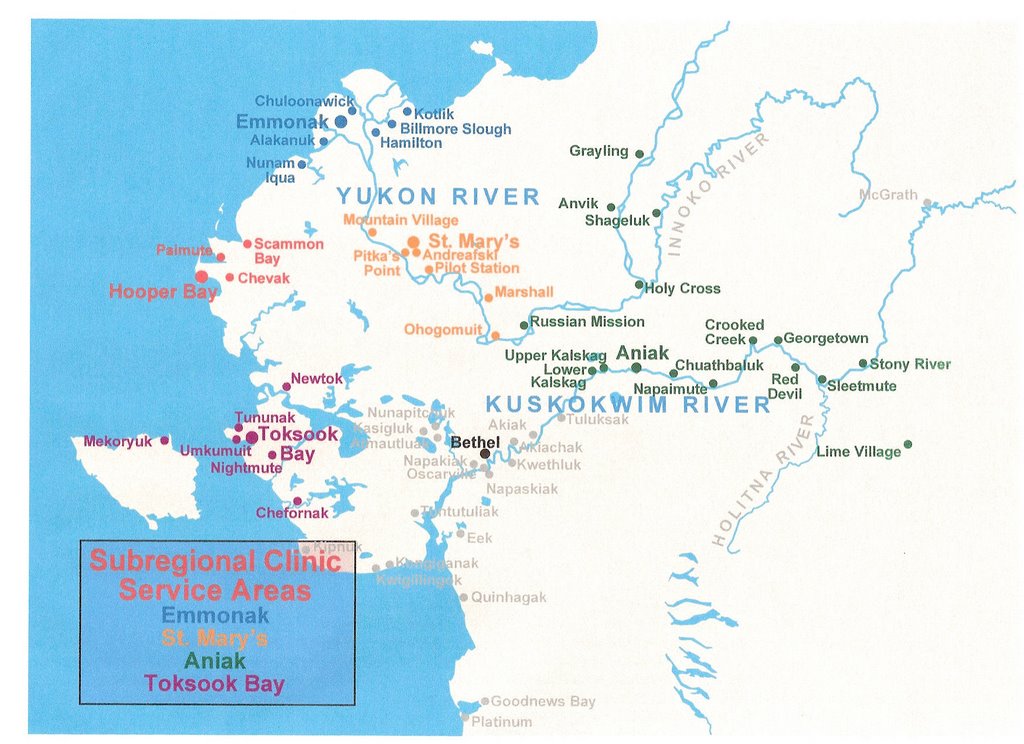
The Villages of Southwest Alaska


A gray, cold, windy Saturday and I think perhaps it would be a good time for a geography lesson. Most maps of Alaska show only a few of the villages of the southwest quarter of the state. I've mentioned several of them in previous posts, and I thought you might like to see where they are. I love maps anyway; my dad taught me how to read one when I was pretty young, and I've always enjoyed pouring over them.

When I first came to Bethel in 1998, I was fascinated by the village names. Some of them are quite lyrical and fun to pronounce; kwig-a-LING-guk sounds like a bird call to me. AK-i-ak sounds like laughter. And e-MUNG-UK sounds like throat clearing. Yupik is a very gutteral language, with many sounds deep in the throat, so it makes sense.

The entire region between the Yukon River and the Kuskokwim River is referred to as the Y-K Delta. There are 58 villages in this region, home to about 20,000 people. The great majority are Yupik Eskimo. The smallest villages--Nunam Iqua, Oscarville, Pitka's Point, Lime Village, Stony River--have less than 50 people. The largest village, Hooper Bay, has about 1200 people. Most villages are in the mid-range, with populations of 400 to 600.

Each village has a health clinic staffed by community health aides with very limited services available. Health aides can draw blood to send in to the hospital for processing; the only lab tests they can do in the clinic are urine pregnancy tests, rapid strep tests, dip stick test of clean catch urine, and finger-stick glucose. There is no imaging (x-rays) available, and only a limited formulary of medications which health aides can dispense on a provider's order.

There is an intermediate level of care available in the Delta which I have not previously discussed. The hospital operates four larger Sub-Regional Clinics in the villages of Aniak, St. Mary's, Emmonak, and Toksook Bay, with a fifth planned for Hooper Bay in the next few years. These clinics are staffed by two mid-level providers (physician assistant or nurse practitioner), in addition to community health aides. They have x-ray machines capable of doing chests and extremities; these are initially read by the PA or NP, and then transmitted electronically to Bethel for reading by a radiologist. They have small labs capable of doing automated blood tests (ISTAT chemistries, CBCs). And they have a larger pharmacy than village clinics, with more medications available; health aides can only dispense this expanded formulary when the PA or NP is in the clinic. The goal is to also have a full time dentist in each Sub-Regional Clinic (SRC), though that hasn't happened yet. Each SRC does include a fully equipped dental operatory. The Physical Therapy Dept. at the hospital sends one of our four physical therapists on field trips regularly to the SRCs, which helps provide service to patients who cannot travel easily. It is generally easier and cheaper for patients to travel to the closest SRC than to come to Bethel.

When I first came to Bethel, there was only one SRC, at Aniak. The other three have been built in the last few years. There has been discussion in the past of having physicians at the SRCs and mid-levels at all the village clinics. I expect that will eventually happen, and I hope it does. At this point, staffing is such a challenge for us that it is not even a goal that is in sight. The SRCs have not been consistently fully staffed with PAs and NPs in the last two years; and the hospital has never had a full, permanent medical staff in my eight years of experience here. It is hard to find medical and nursing staff that want to come here, and even harder to find ones that want to stay longer than two years. The life here certainly doesn't suit everyone. I feel incredibly lucky to have found my way here, because it does suit me. If there are any hardy and intrepid souls out there who think it might suit you too, let me know. We are always looking for a few good folks who are ready for the adventure of their lives up here at the edge of the planet.

Labels:

About Bethel...Bethelista...

One of my co-workers is THE TUNDRA PA (TTPA) and she has been keeping a blog for about a year now about Bethel and bush medicine. She and I went on a village visit to Napaskiak earlier this week but I feel that you need to know a little more about life and medicine here in southwest Alaska. I have permission to use TTPA's blog on my blog. Her site is
www.tundramedicinedreams.com She has over a year's worth of interesting information! Go take a look!

Wednesday, June 14, 2006

Life in Bethel


Alaska is America’s Last Frontier, and living here has all the flavor of frontier life that most people associate with movies about the Old West. Things are not as polished and genteel here as in most places in the Lower 48, especially for those who live “in the bush.”

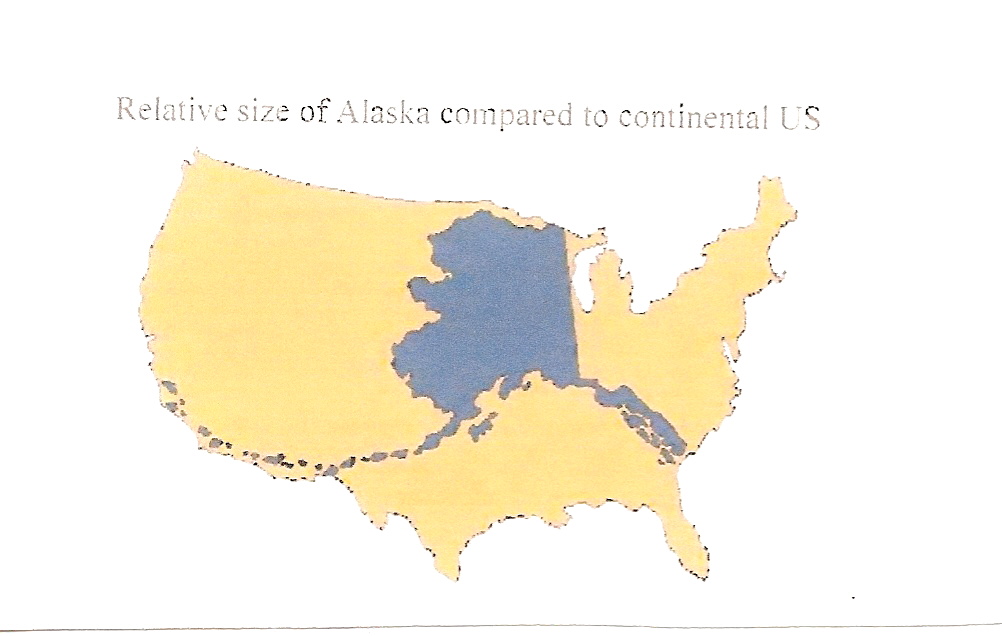
The state of Alaska is huge on a scale that is difficult to comprehend. I particularly like this graphic, as it puts size somewhat into perspective. Alaskans like to say that if you cut Alaska in half, Texas would still be the third largest state. Alaska has 600,000 square miles and 600,000 population, which works out to one person per square mile. But considering that over half the population lives in the three urban centers of Anchorage, Fairbanks, and Juneau—less than 10% of the land—once you leave those centers the population density is more like one person per five square miles. Or something like that, math was never my strong suit. Big, open, and empty of people at any rate.
In all this land there is only a very limited road system, mostly in the central portion of the state connecting Anchorage and Fairbanks (600 miles apart) and the Kenai Peninsula. This little road tangle sprouts off the end of the Alaska Highway, which meanders a few thousand miles down through Canada and connects up with the US highway system along the northern border of the Lower 48. That is a beautiful drive, if you’re interested, but don’t go unprepared. Anyone considering it should buy The Milepost, a guide to driving the Alaska Highway, available from Amazon.com and many bookstores.

Once you get off the limited road system in Alaska, you are considered to be “in the bush.” And now we’re talking truly rural, and very frontier. Goods and services are far more limited, and more expensive. The focus of life is much closer to survival and much farther from elegance. Climate plays some role in that, but distance and geography are huge factors also. Bush Alaska is the edge of the planet in many ways.


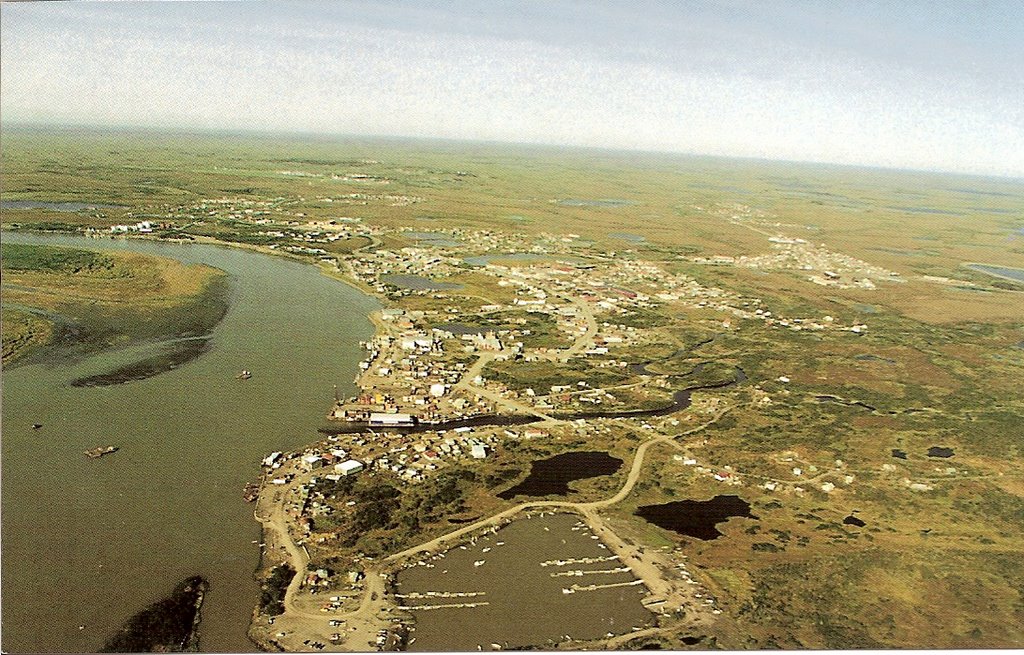
Out here on the edge is the town of Bethel. With a population of about 6,000, Bethel is one of the larger towns in the bush, along with Dillingham, Nome, Kotzebue, and Barrow. Bethel is the hub of southwest Alaska, a somewhat grubby little town (I say that with the greatest affection) perched at the edge of a huge, untamed (unbridged, undammed) river, surrounded by a gazillion miles of open tundra. Truly “out there” in every possible way.


The only way to get here from the Outside World is to fly in, from Anywhere to Anchorage, and from Anchorage to Bethel. Anchorage is very much like any other small Big City in the US (pop. 250,000), only with more gorgeous scenery. Prices are a bit higher, but availability of goods and services and the general feel of life are about the same as in any urban area of the Lower 48. Those who don’t live in Anchorage consider it a suburb of Seattle, and not “living in Alaska” at all. When Bethel folks want to really shop, or see a recently released movie, or eat in a nice restaurant, they “go to town,” which means they go to Anchorage.

Going to town is not cheap. The one-hour flight (400 miles) on Alaska Airlines costs around $500 for a round trip ticket. Occasional specials may drop the price to $300 or so, but those are not frequent. Traveling on to the Lower 48 is also not cheap; round trip Bethel to Seattle is $900 and takes eight hours each way; Bethel to Orlando is $1400 and takes 18 hours. Trips are carefully planned, and most people here don’t travel all that much. We don’t just pop over to Anchorage for the weekend on a whim.

Some people say that there is a time warp between Anchorage and Bethel, and once you land here, you’ve gone back about thirty years (or fifty). The pace of life is slower. Attitudes are different. The flavor of Yupik Eskimo culture informs everything about life here.


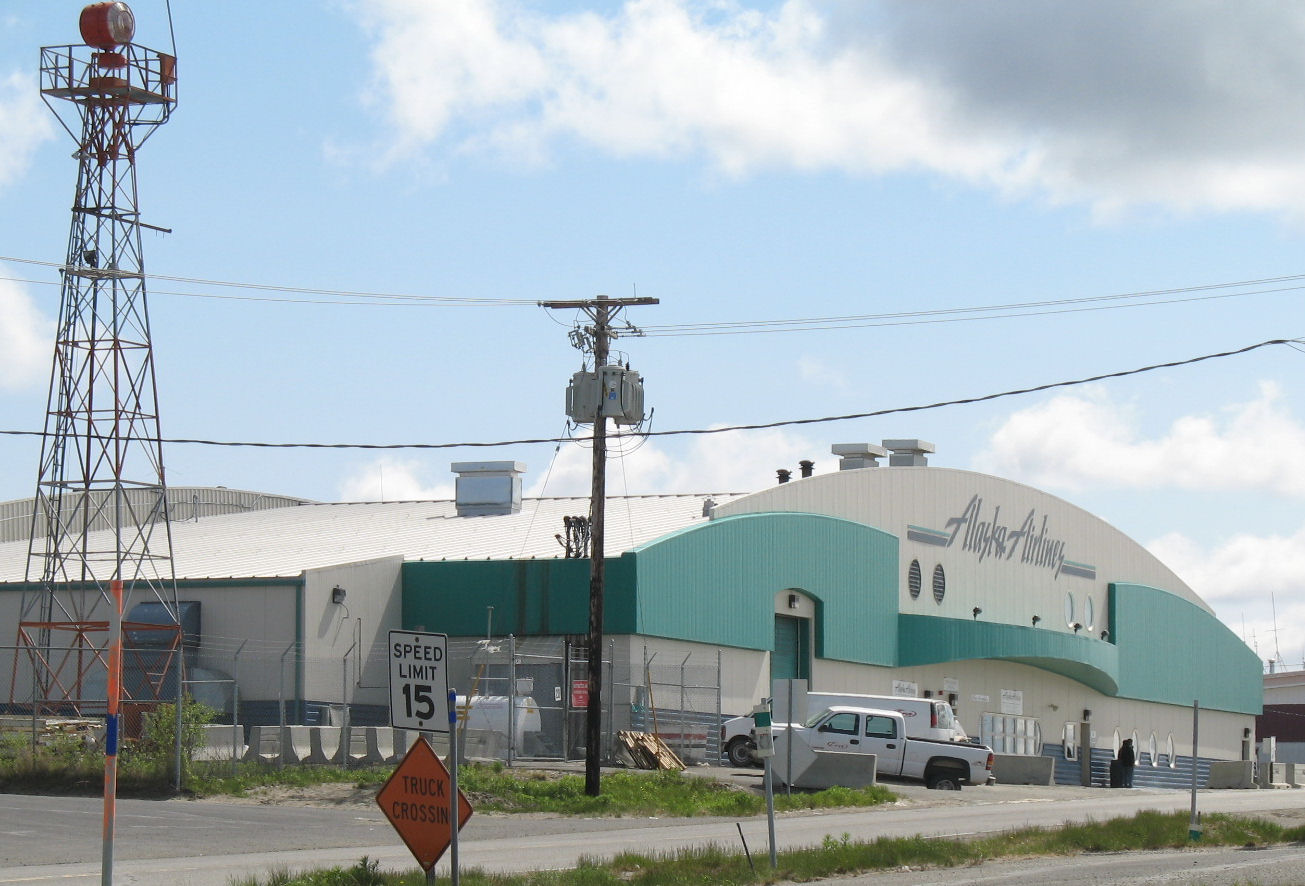
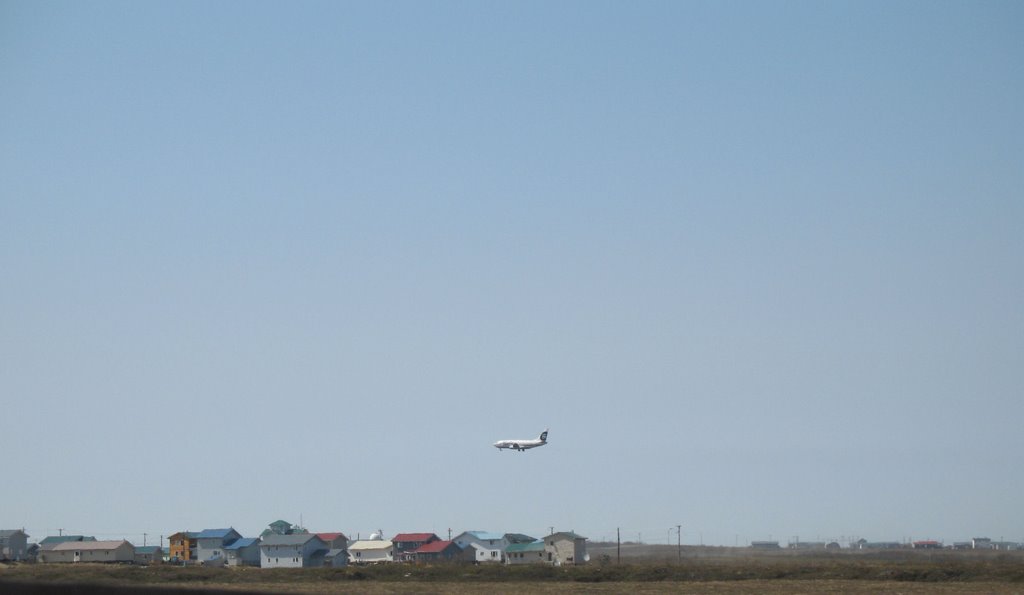
There are four Alaska Airlines jets from and to Anchorage on most days, weather permitting. The airport has two runways. The Alaska terminal has one big room where you check in and wait for your plane; security screening happens just before you walk through the door outside onto the tarmac to board. When you fly in, baggage claim is in the same room, so while you wait for your luggage,


you can chat with people who are flying out. Turn-around time from touch down to lift off is only about 40 minutes, so it happens pretty quickly. Opportunities to come or go occur at 8 am, noon, 4 pm, and 8 pm. You can see the jet land and take off from anywhere in town, and even though you may not want to leave, there is a sense of reassurance in that visible confirmation that the lifeline is intact. A few days without a jet and the grocery store shelves are pretty bare; we are very dependent on the connection.
The airport is about three miles from the center of town, and the ride in is bumpy one. Much of the road is paved, but laying pavement on tundra is not like paving hard ground; tundra shifts, heaves, and moves with temperature variations. We are living on a permanent ice cube covered with a mud layer and topped with a thick carpet of shallow-rooted plant growth. Roads buck and pitch and don’t stay where you put them.

Houses do the same thing, and one of the odder aspects of living here is that you have to have your house leveled every year or so. Frost heaves cause the foundation to shift, and suddenly your doors and windows don’t close anymore. Houses here are all built up on pilings (no such thing as a basement in Bethel) similar to beach houses in the Lower 48. When the door won’t close right, or there is a new crack in the sheetrock, it’s time to call one of the house leveling companies. They will come over and jack your house up, stuff a few shims on the piling, and ease it back down. And charge you three to four hundred bucks, depending on how unlevel it is, how big it is, and how long it takes them.


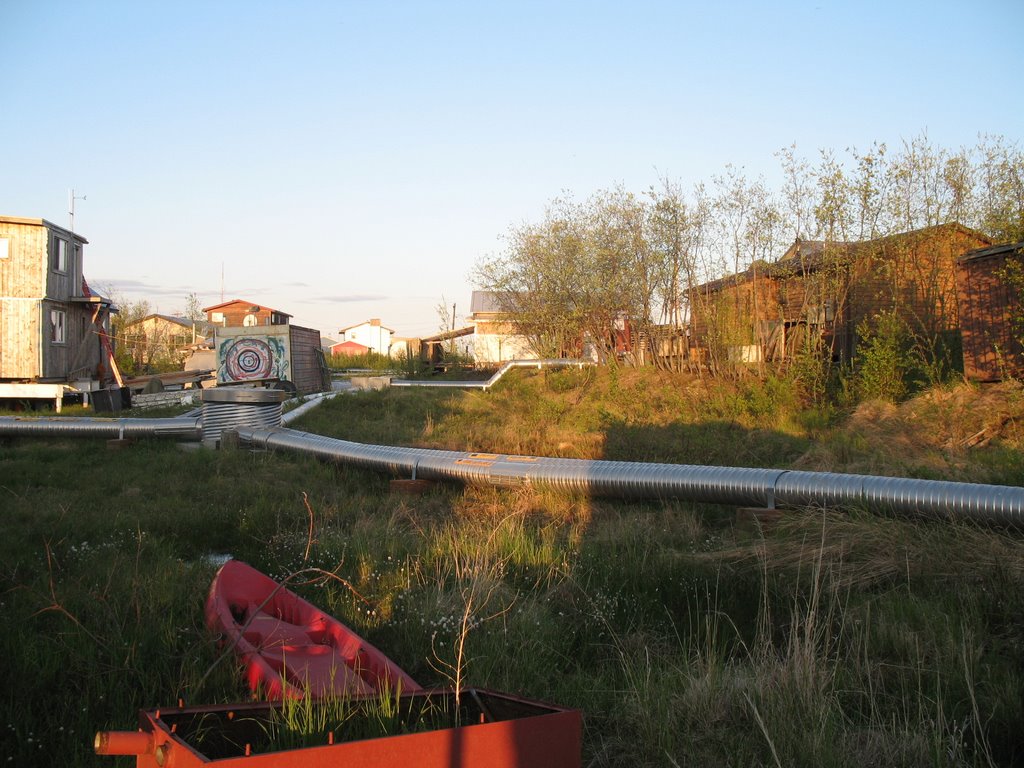
The shifting ground is also the reason that Bethel does not have an underground water and sewer pipe system. Until about ten years ago, there was no piped water or sewer at all. In the mid 1990s, a huge construction project was begun to bring piped water and sewer to Bethel, and about a quarter of the town now has a piped system. The pipes cannot be buried, however. They are built on top of the ground, and are somewhat of an eyesore, but you sort of get used to them.


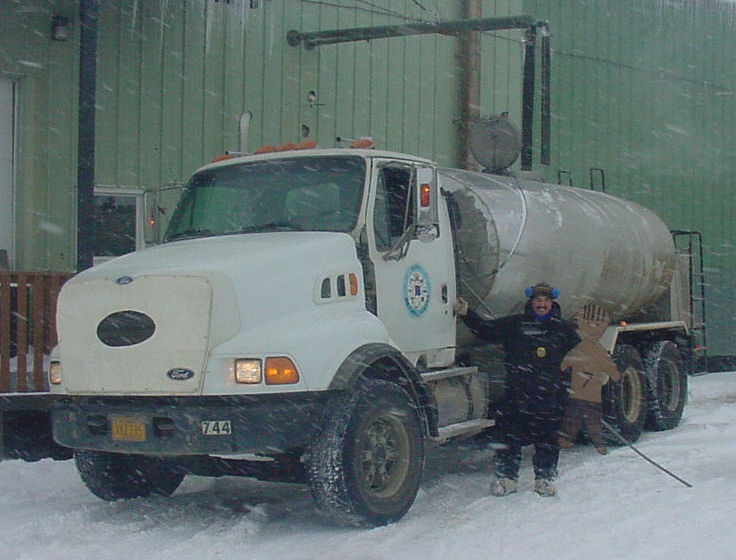
People without piped water are on the hauled water system. Each home has a large water tank, usually 500 to 1500 gallons. The town operates a fleet of trucks that deliver water to the homes


once or twice a week. (I took this photo of a water truck getting filled at the pump house last December; the driver is holding "Flat Stanley" for a project that I was helping with.) A thousand-gallon water tank is about 8 ft. long by 3 ft. wide by 7 ft. high, and most tanks are inside the home to prevent freezing. Water conservation is absolute; you do NOT want to run out of water. When you turn on a faucet, you hear the water pump start up, and you become very attuned on a subliminal level to that sound. If no one is taking a shower or doing laundry, the pump should not be running for more than a minute; if it does, start looking for the source of water loss. A leaky toilet will empty your water tank faster than you’d ever think possible. No letting the water run while you brush your teeth. No cavalier approach to doing dishes. No long, hot, 40-gallon showers. No flushing the toilet when all you did was pee.
The other half of this system is hauled sewer. Each home has a sewer tank (outside), emptied weekly by the town’s fleet of sewer trucks. Each truck evacuates three or four sewer tanks and then drives out to the sewer lagoon for emptying. We have no sewer treatment facility; ours is said to be the second largest sewer lagoon in North America.

It is the homeowner’s responsibility to keep the access pipes for water and sewer unfrozen and easily accessible to the big trucks. The last thing you want is to come home from a day’s work to find you’ve been “green tagged” by the water or sewer truck driver. Then you have to get out the propane torch, melt the ice blockage, and call the Dept. of Public Works to schedule another delivery or evacuation.

Until very recently (like only a few years ago), many homes in Bethel did not have sewer tanks or toilets. They had honey buckets. Literally, a five-gallon plastic bucket with a removable toilet seat and lid. When the bucket got full, it was set in the home’s entryway and the sewer man came into the house and picked it up, dumped it into the truck, and set it back empty. If it froze, he left it there, and you had to warm it up enough to thaw before he’d take it. Large families might fill four or five buckets between visits from the sewer man. Bethel outlawed honey buckets about five years ago, but some renegade types still have them, and empty them in trash dumpsters around town (also illegal).

Garbage removal happens only at the level of the dumpsters; there is no home pick-up. Each home in Bethel pays $12 per month for the privilege of carrying its trash to the dumpsters of choice. There is one on nearly every corner, so it isn’t that hard. Bethel only has two garbage trucks, and they work six days a week keeping the dumpsters empty. Dumpsters are “adopted” by groups, or by the neighborhood they reside in, and are painted according to the whimsy of the adopters. That is a subject for a post all its own, as a new round of adoption is coming up this summer and the new paint jobs will make great photo subjects.

There are other “common conveniences” that Bethel does not have. No home delivery of mail; everyone has a post office box. No drive-up window at the bank; everyone has to go inside. No drug store; the only pharmacy in town is at the hospital, and all prescriptions are filled there. No alcohol of any kind sold in town; Bethel is “damp,” which means it is ok to have alcohol shipped in, but none is sold legally in town. There are bootleggers selling rotgut for exorbitant prices, but most people order deliveries out of Anchorage. It is a two-day process to drive your order out to the cargo handler at the airport and then return the next day to pick up the shipment. Most of the villages are completely dry, and no alcohol of any kind is allowed. Village safety officers are authorized to confiscate any alcohol brought to the village.

Shopping in Bethel is an experience in itself. There are two locally owned (not chain) grocery stores, and both carry a far more limited selection of fresh vegetables, meat, canned goods and other supplies than the average Safeway. At far higher costs. A gallon of milk is about $8. A nice New York strip steak goes for $10.79/pound. A box of cereal costs $7 or more. Bread is $4 per loaf. It is interesting to watch people go through the check out line. The customer’s level of astonishment at the amount due is inversely proportional to the amount of time s/he has been in Bethel. After a while you get used to the fact that the weekly grocery bill for two people will run about $300. It helps a lot when your freezer is full of moose, caribou, and salmon.

There are a dozen or so restaurants in town, and all are outstandingly mediocre. They all have roughly the same menu, with Chinese food, pizza and hamburgers figuring prominently. The only franchise restaurant we have is a Subway.


The pace of life is very relaxed. Nobody really dresses up for anything. The only suits and ties you’ll see are on lawyers in court. There is nowhere to go that requires “evening dress,” and somehow the overall impression of a gown is somewhat marred by wearing it with snow boots.

Entertainment is pretty much self-made. There is no movie theatre, no bowling alley, no video arcade, no shopping mall, no pool hall, no tavern, no skating rink. Visiting friends, having potlucks and barbeques, playing games and just spending time together is the primary entertainment.

The medical staff recruiters for the hospital have an info packet which they give to newcomers; it contains a sheet called Things To Do in Bethel. The list contains the following suggestions:

Ask KYUK about volunteering on the radio
Ask someone about the medicinal uses of plants
Check out videos from the library
Clean up around your dumpster
Go Fishing (Ice Jigging in Winter; Rod & reel in summer)
Go on a bird walk
Go out for lunch
Go to a sled dog race
Go to a dance (Fiddle Dance at the Armory or Sober Dance at the alcohol treatment center)
Go to a quilt guild meeting
Go to a softball game
Go to Hangar Lake and watch the floatplanes
Have a potluck
Help clean up a dog yard
Learn how to harness dogs
Learn some Yup’ik words
Learn the names of different tundra plants
Learn to cut, dry, and smoke fish
Learn to sew fur
Learn to use an ulu (Eskimo knife)
Learn which villages are where in the Delta
Look at the graves in the cemetery
Make a basket
Make a kuspuk
Pick berries
Pick up a bag of trash off the tundra
Plan a camping trip on the tundra
Play on the playground equipment at Pinky’s Park
Read an out of town newspaper at the library
Read the editorials in the Tundra Drums or the Delta Discovery, Bethel's weekly newspapers
Ride a snow machine on the bluffs
See how many different tundra flowers you can find
See what new books are at the library
Take a Yup’ik dance class
Take a walk on the frozen river
Try agutaq (Eskimo ice cream)
Visit the Bethel History Display at the Cultural Center
Visit the displays at Fish and Wildlife
Volunteer at Bethel Health Fair
Volunteer at Cama-i, the annual dance festival
Volunteer at K300 headquarters (the annual dog sled race)
Volunteer to read to children at the library during Children’s Reading Hour
Watch the barge unload
Watch the commercial fishing boats come in and unload huge totes of salmon


Minun tyokaveri on THE TUNDRA PA ja han on kirjoittanut Bethelista bloggiin jo yli vuoden. Minulla on lupaa kayttaa hanen blogia mutta voitte kayda katsomassa hanen blogis myos! Tosi mielenkiintoinen!
www.tundramedicinedreams.com

Alaskan osavaltio on erittain suuri. Alaskalaiset tykkaa sanoa etta jos laitat Alaskan puoleksi, texas ois viela amerikan 3 suuri osavaltio! Alaskassa on 600,000 nelio-mailia ja 600,000 asukasta, eli 1 asukas per maili. Yli puolet asuakkaista asuvat kolmessa kaupungissa Anchorage, Fairbanks ja Juneau.

Taalla on tosi vahan teita. Suurimman osan keski Alaskassa mika menee Anchorige:sta Fairbanksiin.

Bethelissa on noin 6,000 asukasta ja on yksi suurimmista perukka kylista yhdessa Dillingham, Nome, Kotzebue ja Barrow:in kanssa. Bethel on lounas Alaskan paa-kaupunki, suuren Kuskokwim joen varrella.

Ainut tapa paasta Betheliin on lentamalla Anchorige:n kautta tanne. Anchorage on tosi kaunis ja ihan mukavan kokoinen paikka- 250,000 asukasta. Hinnat ovat vahan korkeammat ja sielta pystyy ostamaan ihan kaikkea kun muissa “alemmissa 48” osavaltioissa.

Lentaminen Anchorage:iin ei ole halpaa. Lento kestaa noin tunnin. Matkaa on noin 600 km. Hinta on noin $400. Lentaminen “alempiin 48” ei ole halpaa myoskaan. Anchorage:sta Miamiin on $1400 ja kestaa 14t. Melkein yhta pitka matka kun Suomeen!